
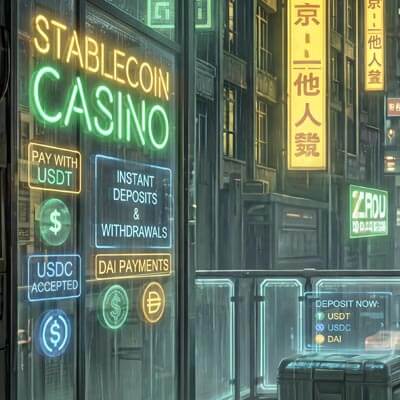
The year is 2121, and a cryptocurrency price chart has escaped from the Decode Casino treasury. It leaps over a fountain, vaults across the neon ceiling, and nearly knocks Spade out of his teleportation chair.
Ms. Moolah hears the alarm and hurries over on her diamond-trimmed hoverboard.
Spin Doctor zooms toward the scene on his electric-cycle attachment and when he spies his friends on the horizon, raises his cybernetic arm toward the racing chart.
“Could our money stop doing acrobatics for five minutes?” Spade asks. Ms. Moolah chuckles.
Across the room, another display stays almost perfectly still. Its quiet glow looks inviting. Suspiciously inviting.
The trio enter the payment vault to investigate stablecoin casino payments: what stays steadier, what definitely doesn’t, and which tiny technical choices determine whether money reaches its destination.
6 Clues Before the Wallet Portal Opens
Ms. Moolah summons a six-sided Decode Casino evidence crystal above the cashier. Each side holds a different clue; this is a checklist, not another payment machine.
- Stability is a target. Dollar-pegged stablecoins are designed to track a dollar in market value, often through reserves and redemption arrangements. Their prices can still drift or lose the peg.
- Bitcoin follows another path. Bitcoin’s dollar price floats with market demand. The same coin amount can become worth more or fewer dollars while it remains in your wallet.
- The network matters. A stablecoin symbol may appear on several blockchain networks. A supported token sent over an unsupported chain can create a serious payment problem.
- Tokens aren’t banknotes. Holding a stablecoin can involve issuer, reserve, custody, and redemption risks that ordinary dollars in a bank account do not share in the same way.
- Casino support is specific. A website accepting Bitcoin does not automatically support USDT, USDC, or every network on which those tokens exist. Deposits and withdrawals can have different options.
- Game odds remain separate. Stablecoin casino payments move value. They don’t improve a game’s RTP, help predict an RNG, or guarantee that a session will finish ahead.
“We have six clues,” Spade says. “I was hoping for six free coins.”
“The clues don’t pay,” Ms. Moolah replies. “They keep us from choosing the wrong portal.”
The Dollar That Wears a Crypto Suit
Spin Doctor opens a Decode Casino quantum wallet. One hundred illuminated tokens rise from it, each marked with the dollar symbol. A stablecoin is a token designed to maintain a reference value, often around one US dollar. Familiar examples include USDT and USDC, with different issuers.
“A hundred tokens, about a hundred dollars,” Ms. Moolah says. “Assuming the peg holds and ignoring fees.”
“So this dollar wears a crypto costume,” Spade says, “but it isn’t carrying a banknote in its pocket?”
That last qualification matters. Stablecoin casino payments can be easier to follow in dollar terms than a moving fraction of Bitcoin, especially between a deposit and a later withdrawal. But the token is not automatically identical to a bank dollar, nor is every stablecoin built the same way. The calm screen is showing an intention, not an unbreakable law.
The Bitcoin Roller Coaster Experiment
The Decode Casino payment vault splits into two platforms. On one, Spin Doctor places $100 worth of Bitcoin at the moment of transfer. On the other, Ms. Moolah places one hundred dollar-pegged stablecoins.
If Bitcoin falls 10%, the same Bitcoin amount might now be worth roughly $90. If the stablecoin holds its dollar peg, the hundred tokens remain worth roughly $100. That is the central appeal of stablecoin casino payments: less exposure to Bitcoin-style price swings while you hold the payment asset.
“I like the calmer platform,” Spade says.
“Look under the platform,” Ms. Moolah replies. “If the peg slips to 97 cents, those hundred tokens represent roughly $97.”
Neither platform offers a guarantee.
Why a Quiet Price Can Hide Other Risks
Spin Doctor’s cybernetic visor sees through the stablecoin platform. Beneath it lie vaults, reserves, redemption mechanisms, wallets, and legal notices, each suspended in a different gravity field. The scene is wild; the questions are real.
Some stablecoins rely on assets held by an issuer; others use different arrangements. Users may face risks involving reserves, redemption, issuer controls, technical problems, or a temporary loss of the peg. Liquidity can also matter when somebody wants to exchange tokens quickly.
“So the quiet display doesn’t mean nothing can go wrong?” Spade asks.
“Exactly,” Spin Doctor says. “Different risks, not missing risks.”
“Then I want to see what’s supporting the token,” Ms. Moolah says, “not just admire its calm face.”
That is the next clue in stablecoin casino payments.
One Token, Several Very Different Roads
The floor becomes a star map. The letters USDT hover above multiple illuminated pathways, none of them connected by a convenient pedestrian crossing. Spade begins dragging a token toward the brightest path until Ms. Moolah catches his wrist.
“Read the destination first,” she says.
“Same token name, different starlanes,” Spin Doctor warns. “The blockchain must match too.”
USDT and USDC may circulate on more than one blockchain. A casino might accept a particular token on one network, a different network, or not at all. The token name alone doesn’t settle the question. Fees, addresses, and confirmations can vary.
For stablecoin casino payments, match the token and blockchain network shown by the actual cashier. Never assume a visually identical ticker makes two routes interchangeable – recovering a mistaken transfer may be difficult or even impossible!
The 4-Check Launch Sequence
Spin Doctor projects four large symbols from his arm onto the launch pad:
- TOKEN
- NETWORK
- ADDRESS
- AMOUNT
One by one, the friends inspect them like a spaceship checklist. Even Spade avoids the biggest glowing button.
“So I confirm the exact token,” he says. “Then the chain, destination address, and amount.”
“Also check fees, minimums, and whether the method works for withdrawals,” Ms. Moolah adds.
If a payment processor converts crypto, check when its exchange rate is fixed and what currency reaches your casino balance. Stablecoin casino payments may be credited as dollars, not tokens.
“My wallet says SENT. Why does our cashier still say PENDING?” Spade asks.
“Blockchain confirmation and casino credit are different checkpoints,” Spin Doctor replies. “Keep the transaction ID.”
Why Operators Are Interested Too
The trio enters the treasury’s merchant gallery, where thousands of cross-border transfers hum through translucent tubes. Both today and in 2121, businesses receiving volatile crypto may prefer to reduce their exposure to large price movements, whether by accepting stablecoins directly or converting assets through a payment partner.
For operators, stablecoin casino payments can be interesting for treasury handling and transfers. For players, a more familiar dollar reference may make amounts easier to understand. But compliance, regional rules, and interplanetary integrations determine what any casino offers.
“So stablecoin can be better for bookkeeping?” Spade asks.
“It’s not glamorous,” Ms. Moolah says, “but reconciling what arrives matters as much as sending it.”
What Matters Today
A portal reveals present-day Decode Casino. Our Banking page lists Bitcoin, Bitcoin Cash, Bitcoin Lightning, Litecoin and Ethereum for deposits, and Bitcoin for crypto withdrawals. Our Bonuses page mentions Tether, without confirming cashier availability.
“Our own pages mention different coins?” Spade asks.
“Yes,” Spin Doctor says. “We should not invent a USDT button or a launch date.”
“Our live cashier and support team can clarify any changes before funds move,” Ms. Moolah adds.
Before making stablecoin casino payments at Decode Casino, confirm the network, fees, limits, account currency and available withdrawal methods.
Stable Payments Don’t Set Your Gambling Budget
Ms. Moolah quantum mind-moves the treasury into a little garden terrace above the city. The volatile Bitcoin chart remains visible while the quieter stablecoin display floats beside it. Neither gets a vote on how much money the friends should spend.
At Decode Casino, a smooth transfer does not change the house edge or protect you from losses. Choose a payment method you understand, verify its rules, and set your entertainment budget before play. No token is universally best; support, costs, risks, and comfort all matter.
“A calmer wallet isn’t permission for a wilder session,” Ms. Moolah says.
“So the payment portal can’t make a slot kinder?” Spade asks.
“Exactly,” Spin Doctor says. “Its blockchain has no control over a game’s RNG.”
Final Transmission
Back at the Decode Casino vault, the two charts settle into separate windows. Spade now knows what to ask.
“Bitcoin can swing in dollar value,” he says. “Stablecoins try to resist those swings.”
“And a peg doesn’t eliminate network, issuer, or redemption risks,” Spin Doctor adds.
“So check the real cashier before moving money,” Ms. Moolah says. “Then keep your limits.”
Your Mission: Confirm the Coin and Chain
Transmission complete, Decoders. When funding your account at Decode Casino, always confirm the token, network, address, fees, and the currency your account will hold.
Ready to join the mission? Hit that red “Register” button above, and we’ll see you inside.